Oracle EBS Consultants | Off-Site Oracle E-Business Suite Consultancy
Oracle EBS Consultancy That Works Around Your Business
- 1.Oracle EBS Consultancy That Works Around Your Business
- 2.What Does an Oracle E-Business Suite Consultant Do?
- 3.Functional vs. Technical Oracle EBS Consultants: Which Do You Need?
- 4.The Off-Site Oracle Consultancy Model: How It Works
- 5.Core Areas of Oracle EBS Expertise AppsolveGroup Covers
- 6.When Should Your Organisation Engage an Oracle EBS Consultant?
AppsolveGroup provides off-site Oracle EBS consultancy across functional and technical disciplines, giving businesses access to specialist expertise without the overhead of permanent headcount.
- ✓Off-site Oracle EBS consultancy structured around your existing team and schedule
- ✓Coverage across functional areas including Financials, Supply Chain, and HR, as well as technical disciplines such as workflow, reporting, and integrations
- ✓Experienced oracle ebs consultants who work across multiple industries and EBS versions
- ✓Flexible engagement models suited to project work, ongoing support, or knowledge transfer
- ✓No long onboarding cycles — consultants get up to speed fast and deliver from day one
Oracle EBS Consultancy That Works Around Your Business
Finding oracle ebs consultants who genuinely understand your business — not just the software — is harder than it should be.
Most organisations running Oracle E-Business Suite hit the same wall. The system is complex, the in-house team is already stretched, and bringing in the wrong support ends up costing more time than it saves. We see this constantly during technical and functional engagements.
AppsolveGroup works differently. Consultancy is delivered off-site. That keeps costs predictable and avoids the disruption that comes with embedding contractors on-site long-term. You get direct access to specialists when you need them — focused on the work, not on finding their feet.
Our team covers the full breadth of Oracle EBS disciplines:
- ✓Functional: Financials (GL, AP, AR, FA), Order Management, Procurement, Inventory, HR and Payroll
- ✓Technical: Oracle Workflow, BI Publisher, Oracle Reports, PL/SQL development, API and web service integrations, data migration
Not generalists who have read the documentation. Consultants with direct, hands-on experience — whether you need help stabilising a live environment, extending functionality, or preparing for an upgrade.
The tricky part with EBS engagements is fit.
A consultant who ignores your existing team structure or bulldozes internal processes creates friction fast. We see this play out regularly. Engagements are scoped around your delivery timeline, your people, and how your business actually runs — not the other way around. We fill genuine gaps and transfer knowledge as we go, so when the engagement ends, your team is in a stronger position than when it started.
Further Reading on Oracle EBS
Running Oracle EBS and need specialist input? A single workstream, end-to-end project delivery, or something in between — we are set up to help without the usual overhead. The work gets done, the knowledge stays with your team, and your system keeps running.
What Does an Oracle E-Business Suite Consultant Do?
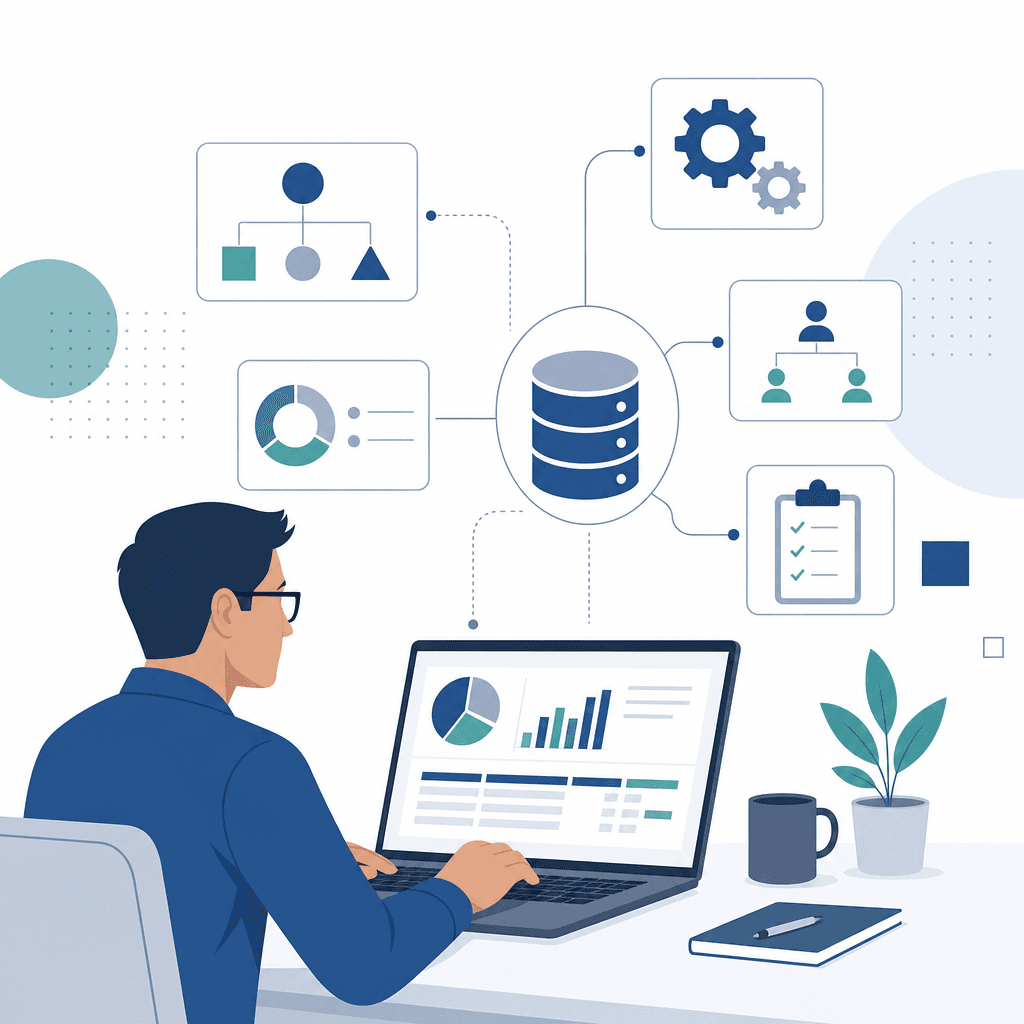
Oracle E-Business Suite is a broad, deeply integrated platform. And the consultants who work with it are not a single type. Understanding what these professionals actually do — and how their roles differ — helps organisations make better decisions when bringing in external expertise.
- Oracle EBS Consultant
- An Oracle EBS consultant is a specialist who configures, implements, supports, or extends Oracle E-Business Suite to align the platform with an organisation's operational and financial requirements.
At the highest level, Oracle EBS consultants split into two distinct tracks: functional and technical. The distinction matters more than most organisations realise when they're scoping a project.
Functional consultants focus on business processes. They work within modules — Financials, Procurement, Supply Chain, HR — configuring the system, defining workflows, and making sure the software reflects how the business actually operates. In practice, they're the main point of contact for department leads and process owners, translating what the business needs into what the system does.
Technical consultants work beneath the surface. Custom development in PL/SQL and Oracle Forms, building and maintaining integrations, writing Oracle Reports, handling data migrations — that's their territory. They work closely with internal IT teams and become essential the moment off-the-shelf configuration runs out of road.
Most serious engagements need both, running in parallel.
That's especially true during large implementations or post-merger consolidations, where the functional and technical workstreams are constantly feeding each other.
In our experience, organisations often underestimate the need for functional depth during an EBS implementation. Getting the configuration right from the start is far less costly than correcting process gaps after go-live.
Typical Engagement Models
How consultants are brought in varies significantly depending on the organisation's size, internal capability, and project scope.
- Project-based engagements are common for implementations, upgrades, or specific module rollouts. The consultant is brought in with a defined scope and exits once the work is complete.
- Off-site support suits organisations that need ongoing functional or technical assistance without the cost of a permanent resource. Work is delivered remotely, often under a managed service or retainer arrangement.
- Hybrid models combine on-site presence for workshops, go-live support, and stakeholder engagement, with off-site delivery for day-to-day development and configuration work.
This is increasingly the standard for mid-to-large implementations. Each model has its place — the right choice depends on how much internal Oracle capability you already have.
Core Tools in an Oracle EBS Consultant's Workflow
- Oracle E-Business Suite
- SQL*Plus
- Oracle Application Framework (OAF)
- Oracle Reports
- Oracle Workflow Builder
- PL/SQL Developer
- JIRA
- Confluence
What to Expect from a Qualified Consultant
A qualified Oracle EBS consultant should arrive with demonstrable module-specific experience. Not just general Oracle familiarity. Actual implementations in your sector, with clear answers about the configuration decisions they made and why.
The tricky part is knowing what good looks like before you've hired someone.
Watch for consultants who flag risks early, communicate clearly on scope and progress, and are upfront about what they'll need from your internal team to keep things moving. The best ones operate as an extension of your team — they document what they build, train the people who'll maintain it, and hand over in a structured way rather than disappearing after go-live.
What they should not do is work in isolation, overcomplicate solutions, or leave your team dependent on them for routine tasks. A good engagement builds internal capability alongside delivering the work.
If you finish an implementation and your team can't operate the system without calling the consultant, something went wrong.
Functional vs. Technical Oracle EBS Consultants: Which Do You Need?

When businesses start looking for oracle ebs consultants, this is usually one of the first things that causes confusion. Functional and technical expertise are genuinely different disciplines. Bringing in the wrong type — or assuming one covers the other — wastes time and budget.
It happens more often than you'd expect.
What Functional Consultants Do
Functional Oracle EBS consultants work at the business process level. They understand how your organisation operates and translate that into how Oracle EBS should be configured to support it. The role is less about code and more about alignment.
Typical responsibilities include:
- ✓Business process mapping — documenting how your current processes work and identifying where Oracle EBS modules can replace or improve them
- ✓Module configuration — setting up modules such as Financials, Procurement, Order Management, or HR to match your business rules and approval flows
- ✓User acceptance testing (UAT) — working with end users to validate that the system behaves as expected before go-live
- ✓User training and documentation — building the knowledge your teams need to operate the system confidently
If Oracle EBS isn't aligned with how your business actually works — people are relying on manual workarounds, adoption is low, or a new module needs setting up — a functional consultant is what you need. You can find dedicated support through our functional support service.
What Technical Consultants Do
Technical Oracle EBS consultants work below the surface of the application. Code, infrastructure, and system connections — that's their territory.
Key areas of technical consultancy include:
- ✓CEMLI development — building custom Extensions, Modifications, Localizations, Integrations, and Reports that go beyond standard Oracle functionality
- ✓Integrations — creating data flows between Oracle EBS and third-party platforms such as payroll providers, CRM systems, or logistics software
- ✓DBA tasks — managing the Oracle database and application server, including patching, performance tuning, cloning environments, and backup management
- ✓Performance troubleshooting — diagnosing slow queries, concurrent processing bottlenecks, or infrastructure issues affecting system response
Performance degradation, a broken interface, a custom report that needs building, a patching backlog. These are technical problems. Our DBA and technical support team handles exactly these engagements.
Knowing Which Consultant to Call
A manufacturing company notices that purchase orders are being raised incorrectly and approvals are being bypassed. The finance team assumes this is a technical bug. In fact, the approval hierarchy in Oracle Purchasing was never fully configured after an organisational restructure. This is a functional issue — a functional consultant would review the AME (Approval Management Engine) setup and reconfigure it to match the current business structure. No development work is required.
Can One Consultant Do Both?
Rarely well.
Some consultants have exposure across both disciplines. But genuine depth in both is uncommon. A functional consultant who has picked up some SQL is not the same as a qualified Oracle DBA. A developer who understands configuration doesn't replace someone with real process design experience.
The tricky part is that both types can sound credible outside their core area — until the engagement runs into trouble.
For most businesses, the safer approach is to be clear about the nature of the problem before engaging anyone. That clarity also makes it easier to scope the work and hold a consultant accountable to outcomes.
Pros
- Functional consultants improve adoption and reduce manual workarounds without any code changes
- Technical consultants can solve problems that configuration alone cannot address
- Engaging the right type of consultant reduces project scope creep and keeps costs predictable
- Specialist consultants tend to resolve issues faster than generalists attempting to cover both areas
Cons
- Misidentifying the problem type means engaging the wrong consultant and paying for work that doesn't fix the issue
- Splitting functional and technical work across two consultants requires more coordination overhead
- Some engagements genuinely require both skill sets, which increases cost and complexity
- Functional consultants cannot resolve infrastructure or performance problems, no matter how experienced they are
How to Diagnose Your Situation
So where do you actually start? Before reaching out to any consultancy, run through these questions:
Step by step
Is the system doing something wrong, or are people using it wrong?
If users are bypassing the system or relying on spreadsheets, that's usually a functional alignment issue — not a bug.
Is the problem consistent or intermittent?
Intermittent slow response times or failed jobs point to a technical or infrastructure problem.
Does a fix require changing how data is stored, moved, or displayed?
If yes, that's technical work.
Has the business changed but the system hasn't kept up?
Organisational changes that were never reflected in the configuration need a functional review.
In practice, many engagements start functional and surface technical requirements along the way — or the other way around. We see this constantly during technical audits: a client brings in a developer for what turns out to be a configuration problem, or expects a functional consultant to fix a performance issue that needs DBA-level access.
Don't assume one type covers the other. That assumption is where projects get expensive.
The Off-Site Oracle Consultancy Model: How It Works
Most organisations assume bringing in specialist support means disrupting their team structure, committing to a long on-site engagement, or both.
AppsolveGroup's off-site model is built around a different premise. Experienced oracle ebs consultants should plug into your environment cleanly, communicate clearly, and get work done without creating extra management overhead for your internal staff.
Here's how it actually works.
Onboarding: Getting Started Without the Noise
Before anyone touches a single configuration, we need to understand your environment.
Your assigned consultant or team lead runs a structured discovery session with your internal stakeholders — finance, IT, operations, or whichever functions are in scope. This isn't a generic questionnaire. It covers your specific Oracle EBS version, module set, existing customisations, open issues, and any upcoming deadlines that will affect the engagement. Access is provisioned through your standard IT security process. No bespoke tooling, no proprietary software layers.
Your team keeps full control of permissions throughout.
By the end of onboarding, both sides have a shared document covering scope, communication contacts, escalation paths, access details, and a delivery schedule. Nothing left ambiguous.
Off-Site Oracle EBS Engagement Lifecycle
Week 1
Discovery and Scoping
Structured sessions with your stakeholders to document environment details, module scope, pain points, and delivery priorities. Access credentials provisioned and shared working document agreed.
Week 2–3
Environment Review and Workplan
Consultant reviews your Oracle EBS configuration, existing customisations, and any outstanding issues. A detailed workplan with milestones is produced and signed off by both parties.
Month 1–2
Active Delivery
Consultant begins scheduled deliverables — configuration, testing, documentation, or advisory work depending on scope. Weekly check-in calls and written progress updates keep your team informed.
Ongoing
Cadenced Review and Adjustment
Monthly reviews assess progress against the workplan. Scope can be adjusted as business priorities shift. Escalation paths are available at any point if urgent issues arise.
Completion or Transition
Handover and Knowledge Transfer
At the close of a fixed engagement, a full handover document is produced. If the engagement extends to retained support, the consultant continues with the agreed cadence and updated scope.
Communication Cadence: Predictable, Not Reactive
One of the most common complaints we hear about external consultants is unpredictable communication. Radio silence. Or a flood of messages with no clear signal.
AppsolveGroup uses a defined cadence from day one. For most engagements that means a weekly written update — work completed, work planned, and any blockers or decisions needed from your side. A short call is scheduled weekly or fortnightly depending on the pace of the work. Your internal contact has a single point of communication. No chasing multiple people to find out what's happening.
All working notes, decisions, and change requests are logged in a shared project tracker. Your team gets a live view of progress without needing to attend every call.
1 dedicated point of contact
Each AppsolveGroup off-site engagement is managed through a single named consultant or team lead, reducing the coordination burden on your internal staff.
AppsolveGroup engagement model
Escalation Paths: When Things Need to Move Faster
No engagement runs entirely without friction. Oracle EBS environments are complex, and business priorities shift.
When something urgent surfaces — a system issue, a project dependency change, a scope question — it needs to reach the right person fast. The escalation path is straightforward:
- Your named consultant handles day-to-day queries
- Senior input from a principal consultant or engagement lead is available within one business day
- For critical production issues, there's a direct escalation line that bypasses the standard weekly cadence entirely
This is all documented in your shared working agreement at the start. No one's searching for a phone number when something goes wrong.
Integrating Off-Site Consultants with In-House Teams
The tricky part of any off-site model is the handoff. Where does the consultant's work end and your team's begin?
AppsolveGroup consultants are explicit about this from day one. Your in-house staff continue to own day-to-day system administration, user support, and business process decisions. The consultant handles the specialist work — configuration, development, troubleshooting, functional design, or whatever falls within the agreed scope.
Where the two overlap, it gets agreed in advance. Testing cycles, change management — neither side should be sitting around waiting on the other.
| Responsibility Area | In-House Team | AppsolveGroup Consultant |
|---|---|---|
| Day-to-day system administration | Owns | Advises on request |
| End-user support and training | Owns | Supports during project phases |
| Oracle EBS configuration and design | Provides requirements and sign-off | Owns delivery |
| Custom development and scripting | Access and testing support | Owns delivery |
| Testing and UAT | Leads UAT with business users | Supports and documents defects |
| Documentation and handover | Receives and reviews | Produces and maintains |
This division isn't rigid. For organisations with limited internal Oracle resource, consultants can take on a broader remit — but scope is always agreed explicitly, never assumed.
Done properly, the off-site model should reduce the load on your internal team. Not add to it.
Core Areas of Oracle EBS Expertise AppsolveGroup Covers
Oracle EBS is a broad platform. Keeping it running, compliant, and fit for purpose isn't one job — it's several distinct disciplines, each requiring real depth. AppsolveGroup's oracle ebs consultants work across all of them, with focused expertise rather than generalist coverage.
Here's what that looks like in practice.
Managed Support
Day-to-day EBS support means more than logging tickets. It covers monitoring, patch assessment, performance issues, and responding to functional queries from finance, procurement, and HR teams. Most businesses don't need a full in-house EBS team. They need consistent, knowledgeable cover when it matters — and that's what our managed support model is built around.
CEMLI and Customisation
CEMLI stands for Conversions, Extensions, Modifications, Localizations, and Integrations. The custom development layer that makes a standard EBS installation actually work for your business.
We see this constantly during technical audits — organisations carrying CEMLIs built years ago, poorly documented, and now creating real upgrade risk. Our technical consultants assess what's there, build what's missing, and document everything so the system doesn't depend on one person's memory to run.
Integrations
EBS rarely operates in isolation. It connects to third-party systems, data warehouses, payroll platforms, and increasingly to cloud applications. Those connections break more often than they should — usually because they were built quickly and never properly maintained.
Our Oracle EBS integration work covers both legacy middleware and modern API-based connectivity, with the goal of keeping those connections stable and adaptable when either side changes.
Key EBS Practice Areas
CEMLI & Customisation
Assessment, development, and documentation of custom EBS components to keep your system aligned with business requirements and safe through upgrades.
Integrations
Stable, well-documented connections between EBS and third-party systems, built using appropriate middleware or direct API approaches depending on your architecture.
Testing
Structured test cycles covering regression, UAT, and patch validation so that changes to your EBS environment do not introduce unplanned disruption.
OCI Migration
End-to-end planning and execution for moving EBS infrastructure to Oracle Cloud Infrastructure, with attention to timeline, downtime risk, and post-migration stability.
Testing
Most SaaS teams miss this. And in EBS environments, the consequences are more severe.
Testing EBS changes — patches, customisations, integrations — takes time and requires people who understand both the technical and functional layers of the system. Skip it or rush it, and you're absorbing that risk in production. Our Oracle EBS testing practice covers regression testing, user acceptance testing, and structured test script development so release cycles are repeatable and reliable. Not a gamble.
Change Management
A technically successful EBS change can still fail. If the people using the system don't understand what's different or why, the project hasn't really landed.
Our Oracle EBS change management work runs alongside implementation and upgrade projects — covering stakeholder communication, training design, and the documentation teams actually need to operate the system confidently after go-live.
Testing Is Not Optional
Inadequate testing before EBS changes reach production is one of the most common causes of post-go-live incidents. Structured test cycles reduce that risk significantly and protect the investment made in the change itself.
Archiving and Data Purging
EBS databases grow. Left unmanaged, that volume affects performance, extends backup windows, and drives up storage costs. Our Oracle EBS archiving and purging service helps organisations identify what can be archived or removed safely — using Oracle's standard purge programs and, where appropriate, third-party archiving tools.
OCI Migration
Moving EBS from on-premise or co-located infrastructure to Oracle Cloud Infrastructure is a significant undertaking. Licensing, network architecture, downtime windows, post-migration configuration — there are a lot of variables.
The tricky part is that most of them interact with each other. A decision made early in the process has a way of surfacing as a constraint three stages later. Our consultants have worked through this with multiple clients and can support the full migration lifecycle. The OCI migration steps and timeline page covers how this typically unfolds and what to expect at each stage.
Explore Our Oracle EBS Services
What ties all of this together is that our consultants understand EBS the way it actually behaves — not just how the documentation says it should. That distinction matters. It's what separates an EBS consultancy that can handle real problems from one that's only useful when everything is already working.
When Should Your Organisation Engage an Oracle EBS Consultant?
Knowing when to bring in outside help is something IT and finance leaders tend to overthink — then act on too late. Most organisations wait until something breaks. By that point, the fix costs significantly more than prevention would have.
There are clear moments where external consultancy pays for itself.
System upgrades and patch cycles
Oracle releases patches and version upgrades on a regular cycle. If your internal team hasn't applied these across multiple environments, the risk of downtime or data issues is real. Consultants working across dozens of EBS deployments build pattern recognition that in-house teams simply can't develop from managing a single instance.
Compliance and audit requirements
Regulatory changes — tax, payroll, financial reporting, data handling — often require configuration work across GL, Payroll, or Purchasing modules. Waiting until an audit is already underway to address gaps is a poor position to be in. Bring someone in ahead of a compliance deadline and your team actually has time to test properly.
Performance issues and slow processing
Slow batch jobs and degraded concurrent processing rarely fix themselves.
They worsen. A technical EBS consultant can profile the system and identify root causes — not apply surface-level fixes that buy you a few weeks.
Staff turnover and knowledge gaps
When a long-serving EBS administrator leaves, they take institutional knowledge with them. How customisations were built. Why certain workarounds exist. What the upgrade history looks like.
We see this constantly during technical audits — environments where critical knowledge lives in one person's head, and that person is gone. Consultants carry out knowledge transfer exercises and produce the documentation that protects you from that dependency.
OCI migrations
Many organisations running EBS on-premise are planning — or already starting — migrations to Oracle Cloud Infrastructure. Networking, storage, database configuration, application compatibility: all of it needs to be right. The tricky part is that gaps in planning don't always surface until you're mid-migration. Consultants who have completed OCI migrations for comparable EBS environments reduce that risk considerably.
Post-go-live stabilisation
The weeks after an EBS implementation or major upgrade are often the hardest. Users surface issues that never appeared in testing. Integrations behave differently under production load. Configuration gaps become visible at the worst times.
Consultants brought in specifically for post-go-live support give that period structure, rather than leaving your internal team to absorb all of it alone.
Signs Your Organisation Needs EBS Consultancy Now
- ✓An upgrade or patch has been delayed due to lack of internal resource
- ✓A compliance deadline is approaching and EBS configuration has not been reviewed
- ✓Batch processing or report generation times have increased noticeably
- ✓A key EBS administrator or analyst has left or handed in notice
- ✓An OCI migration is planned but no structured assessment has been completed
- ✓Your team is managing post-go-live issues without dedicated support
- ✓Customisations exist in your environment with no documentation or known author
⚠ Delaying the Decision
The most common mistake organisations make is treating consultancy as a last resort. By the time a performance problem has affected month-end close, or a compliance gap has been flagged in an audit, the remediation effort is substantially larger than it would have been with earlier intervention. Engaging Oracle EBS consultants at the point where a risk is identified — not after it has materialised — consistently produces better outcomes and lower overall cost.
It's also worth being honest about what internal teams can realistically absorb. EBS environments are complex — modules, integrations, customisations, version history. No single internal resource holds expertise across all of it.
Consultants aren't a replacement for your team. They work alongside it, filling specific gaps at the moment those gaps matter most.
Over 50%
of Oracle EBS environments are running on hardware or infrastructure configurations that Oracle considers end-of-life or approaching unsupported status, making migration planning and expert consultancy increasingly urgent for businesses still on-premise.
Oracle Technology Network Advisory — General EBS Lifecycle Guidance
Talk to an Oracle EBS Consultant Today
A single workstream, end-to-end project delivery, or something in between — AppsolveGroup's off-site oracle ebs consultants are set up to help without the usual overhead. The work gets done, the knowledge stays with your team, and your system keeps running.
Get in TouchCan a functional Oracle EBS consultant configure custom reports?
Standard reports and basic query tools such as FSG (Financial Statement Generator) fall within functional scope. Custom OTBI or XML Publisher reports that require SQL and data model work are a technical task.
Do I need a technical consultant just to apply Oracle patches?
Yes. Patching Oracle EBS — including CPU patches, bundle patches, and application-tier updates — is a DBA-level task. It requires access to the server environment and an understanding of patch prerequisites and rollback procedures.
What is a CEMLI and when do I need one?
CEMLI stands for Customisation, Extension, Modification, Localisation, and Integration. These are bespoke developments added to Oracle EBS when standard functionality does not meet a business requirement. They are built and maintained by technical consultants.
We have a performance problem — should we call a functional or technical consultant?
Start with a technical consultant. Performance issues in Oracle EBS are almost always related to database, infrastructure, or concurrent processing configuration. A functional review will not resolve a slow-running concurrent program or a poorly performing query.
Can one managed support arrangement cover both functional and technical needs?
Yes. A managed support engagement with defined functional and technical resource allocation is often more cost-effective than managing separate specialist contracts. It also ensures better communication when a problem crosses both disciplines.
We have an internal Oracle team. Do we still need external consultants?
Internal teams manage one environment. External EBS consultants work across many organisations and versions simultaneously — they encounter a much wider range of problems, and solutions. The two approaches complement each other. One doesn't replace the other.
How do we justify the cost to leadership?
Frame it around disruption cost. An unplanned EBS outage during financial close, a failed upgrade requiring rollback, a compliance penalty — all of these cost more than a structured consultancy engagement. The question isn't whether to spend the money. It's whether to spend it proactively or reactively.
You might also find helpful
Oracle EBS Implementation Services
End-to-end implementation support for Oracle E-Business Suite deployments.
Oracle EBS Support and Managed Services
Ongoing functional and technical support for live EBS environments.
Oracle EBS Upgrades
Structured upgrade planning and delivery for Oracle E-Business Suite.
Oracle EBS Technical Consulting
PL/SQL, CEMLI, integrations, and DBA-level technical expertise.
Oracle EBS Functional Consulting
Module configuration, process design, and UAT support across all EBS functional areas.
Talk to an Oracle EBS expert
Talk to APPSolve Group for clear, practical guidance from an experienced Oracle partner.
Get in touch about Oracle EBS consultancy
Tshepho and Tim and the wider APPSolve Group team can talk through your situation — no obligation, no generic sales pitch. Just a direct conversation about what a realistic path forward looks like.