Oracle EBS Functional Support
Oracle EBS Module Support That Keeps Your Business Running
- 1.Oracle EBS Module Support That Keeps Your Business Running
- 2.What Oracle EBS Functional Support Covers
- 3.Oracle R12 Modules We Support
- 4.How Our Functional Support Model Works Day to Day
- 5.Critical Period Support: Month-End, Year-End and Regulatory Cycles
- 6.Functional Support vs Technical Support: Understanding the Difference
- 7.Talk to an Oracle EBS Functional Support Specialist
AppsolveGroup provides functional support across Oracle E-Business Suite modules, helping businesses resolve issues quickly and keep critical operations running without disruption.
- ✓Module-level problems in Oracle EBS can halt financial reporting, procurement, manufacturing, and payroll processes.
- ✓AppsolveGroup covers functional support across the core EBS module suite, from Financials to Supply Chain.
- ✓Support is structured around resolving real operational issues, not just logging tickets.
- ✓Clients get access to functional consultants with hands-on EBS configuration and troubleshooting experience.
- ✓Coverage extends to both ongoing support and project-based engagements.
Oracle EBS Module Support That Keeps Your Business Running
Oracle E-Business Suite is a tightly interconnected system. One module fails, and the rest of the business feels it fast.
A period-close issue in General Ledger holds up financial reporting. A workflow stall in Purchasing stops procurement completely. A costing error in Inventory means operations are making decisions on numbers they can't trust. These aren't edge cases — we see this kind of disruption in live environments constantly. Module-level failures have immediate knock-on effects, and most internal teams simply don't have the depth to diagnose them quickly.
AppsolveGroup's Oracle EBS functional support is built around that reality.
Our consultants work at the module level. That means they understand the configuration, setup logic, and process behaviour specific to each application — not just the platform in broad terms.
Coverage spans the full EBS module suite:
- ✓Core Financials — General Ledger, Accounts Payable, Accounts Receivable, Fixed Assets, Cash Management
- ✓Operational modules — Procurement, Inventory, Order Management, Manufacturing, Projects
- ✓HR side — Human Capital Management and Payroll
Whether the issue is a transactional error, a setup gap, or something that broke after a patch or configuration change, we diagnose and resolve it at the source.
So what separates functional support from generic helpdesk coverage? Depth.
A common mistake we see is organisations logging EBS issues with teams that understand the platform but not the module. Problems get closed without being fixed. A functional consultant knows why AutoAccounting rules affect revenue recognition in AR, or why a receiving transaction might fail to match a purchase order in AP. That knowledge is what gets issues resolved correctly the first time — not patched with workarounds that surface problems further down the line.
More on Oracle EBS Support and Services
Support needs vary. We structure our service accordingly.
Some clients need ongoing functional cover — a consistent resource handling day-to-day queries and incidents as they come in. Others need targeted help with a specific module during a process change, an upgrade, or an audit period. We work at whatever level makes sense: hands-on troubleshooting, guidance for your internal team, or alongside your IT function when the root cause sits on the technical side.
The tricky part with EBS isn't usually finding that something's broken. It's knowing exactly where and why — and fixing it without creating a new problem somewhere else.
If your Oracle EBS environment is running but not running cleanly, that's the problem we're here to fix.
Need module-level Oracle EBS support? Let's talk about what cover looks like for your environment.
Contact AppsolveGroupWhat Oracle EBS Functional Support Covers
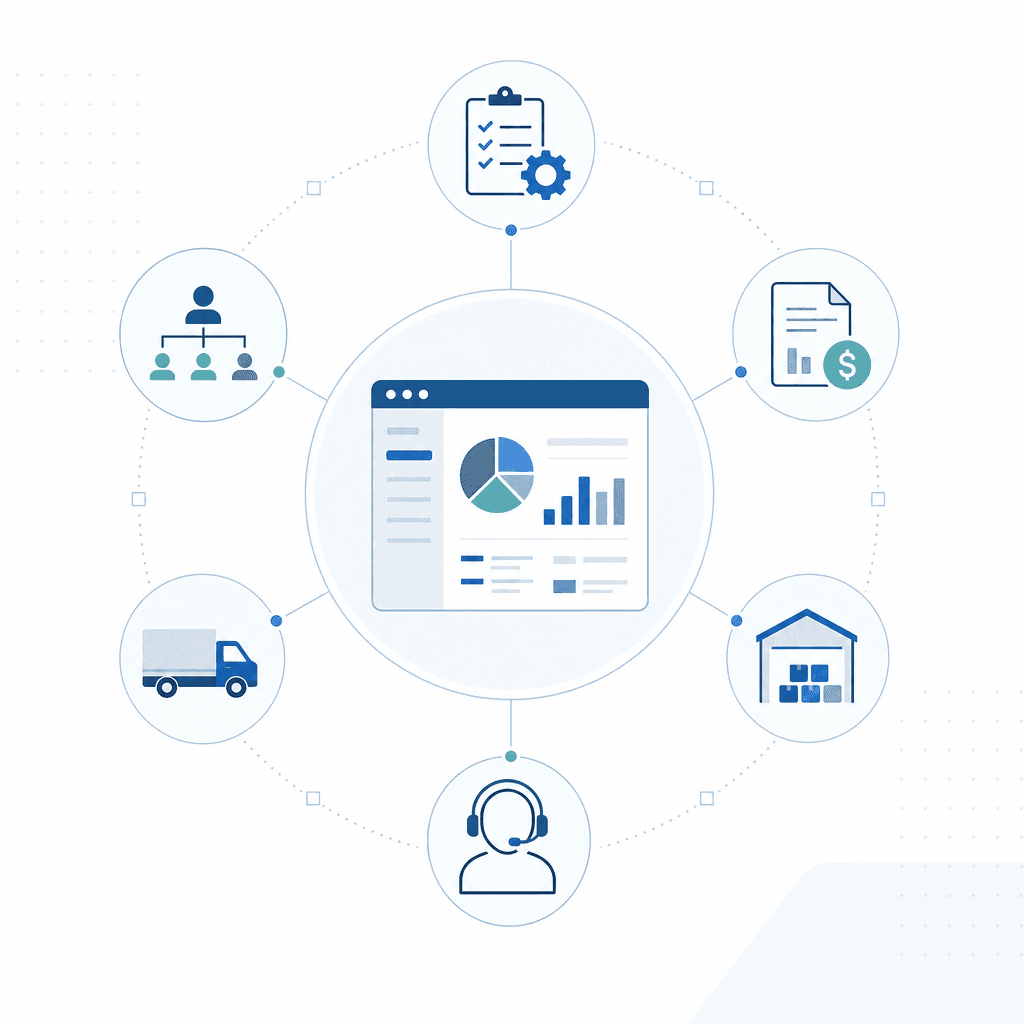
- Oracle EBS Functional Support
- Oracle EBS functional support covers the configuration, troubleshooting, and ongoing advisory services related to how Oracle E-Business Suite modules operate within your business processes — distinct from the database administration and infrastructure work handled by technical or DBA teams.
When businesses talk about oracle ebs module support, two completely different conversations tend to collide. One is about the database layer — server performance, patching, uptime. The other is about whether the software actually works for the people using it every day.
Functional support is firmly the second one.
Functional consultants work inside the application. They know how modules are configured, how business rules are structured, and why a process that ran cleanly last month is throwing errors today. No code. No infrastructure. Just deep knowledge of Oracle EBS at the process and configuration level — which is often exactly where the problem lives.
The Scope of Functional Support
So what does functional support actually cover? Usually it falls across several distinct activity types.
Module configuration and setup changes — Business requirements change. Functional support covers the adjustments that follow: profile options, flexfield configuration, approval hierarchies, workflow rules, and module-level setups across General Ledger, Accounts Payable, Accounts Receivable, Purchasing, Inventory, and Order Management.
Business process troubleshooting — A transaction fails. A report returns results that make no sense. A process stalls mid-way through. This is where functional support earns its keep — investigating the cause at the configuration and process level, not at the database. We see this constantly during technical audits: the root cause is almost never where the team first looks.
User issue resolution — Not every user problem is a bug. A lot of them are process gaps, missing setups, or workflows that were never explained properly. Functional support handles these, clears access issues, and keeps users moving.
Period-end process support — Month-end and year-end closes in Oracle EBS are sequential, cross-module, and unforgiving. Functional support covers close checklists, journal posting, reconciliation checks, subledger accounting, and the coordination needed to get periods closed accurately and on time.
Ongoing advisory — This is the piece most teams underuse. Beyond break-fix, it includes guidance on getting more from existing functionality, input ahead of Oracle patches or upgrades, and process improvement recommendations within your current setup.
The tricky part is knowing which category your problem falls into. Misrouting it wastes time.
Functional vs. Technical Support
Many Oracle EBS issues that appear to be system faults are actually configuration gaps or process errors. Functional support resolves these without the need for developer intervention, reducing resolution time and cost.
Functional Areas Covered
Which modules you run determines the scope. Most engagements cover the core financial and operational suite.
Oracle EBS Functional Support Areas
- ✓General Ledger — chart of accounts, journal entries, allocations, period close
- ✓Accounts Payable — invoice processing, payment runs, supplier setup, holds resolution
- ✓Accounts Receivable — customer billing, receipts, credit management, dunning
- ✓Purchasing — requisitions, purchase orders, approval workflows, receiving
- ✓Inventory — item setup, organisation parameters, transactions, costing
- ✓Order Management — order entry, pricing, shipping, fulfilment rules
- ✓Fixed Assets — asset books, depreciation, additions and retirements
- ✓Cash Management — bank reconciliation, bank statement processing
- ✓Subledger Accounting — accounting rules, journal line types, event classes
- ✓System Administration — user setup, responsibilities, profile options, concurrent programs
The functional versus technical distinction matters when you are working out what kind of help you actually need. If the issue lives inside the application — in how it is configured, how a process behaves, how users interact with it — functional support is the right call. If it involves database performance, server access, or custom code, that is your DBA or technical team.
Most Oracle EBS environments need both. But they serve different purposes, require different expertise, and should not be treated as interchangeable.
Oracle R12 Modules We Support

AppsolveGroup provides functional support across the full Oracle R12 application suite. Multi-entity finance structures, complex procurement workflows, payroll across multiple jurisdictions — our team works directly inside your Oracle EBS environment to keep each module running properly.
Here's what that looks like across each area we cover.
Financials (GL, AP, AR, FA, CM)
Financials is where organisations feel the most pain when something breaks. The knock-on effects move fast, and the pressure to resolve issues is immediate.
We support all core modules:
- General Ledger (GL): Chart of accounts configuration, period close assistance, journal import troubleshooting, and intercompany reconciliation support.
- Accounts Payable (AP): Invoice validation errors, payment processing issues, supplier setup, and withholding tax configuration.
- Accounts Receivable (AR): Receipt application, AutoInvoice setup and error resolution, customer account management, and credit limit configuration.
- Fixed Assets (FA): Asset book configuration, depreciation run troubleshooting, mass additions, and CIP asset management.
- Cash Management (CM): Bank statement reconciliation, bank account setup, and integration points with AP and AR.
That support runs across three layers. Initial configuration and setups. Day-to-day issue resolution. And practical advice on configurations that actually fit your business structure.
Procurement (PO, iProcurement)
Procurement workflows break down at the setup level more often than most teams expect.
We see it constantly — requisitions that won't convert, approvals that stall, and nobody quite sure where in the hierarchy things are going wrong. We support Purchase Orders and iProcurement, covering approval hierarchy configuration, document styles, purchasing options, and catalog and punchout setup. When something breaks, we go straight to the workflow rules, approval groups, and position hierarchies causing the problem.
What Module Support Looks Like in Practice
Configuration
We set up and refine module configurations to match your operating structure — from ledger assignments to approval hierarchies and inventory organisations.
Issue Resolution
When errors appear — failed transactions, blocked workflows, reconciliation breaks — we identify the root cause and resolve it directly in your environment.
Advisory
We advise on how to use Oracle R12 functionality more effectively, including setups you may not be using that would reduce manual workarounds.
Cross-Module Integrity
Many issues originate at integration points between modules. We trace problems across the full transaction lifecycle, not just within a single module.
Order Management
If your sales order flow is breaking down somewhere between shipping and billing, this is where we focus.
Order Management support covers order entry, pricing, holds, shipping, and invoicing integration with AR. We handle order type and transaction type setup, defaulting rules, and errors throughout the order-to-cash cycle — fulfilment holds, shipping exceptions, AutoInvoice failures caused by incomplete order data.
The tricky part is that failures often show up at the billing stage when the real issue is upstream in the order or shipping setup. By the time the error surfaces, it can look like an AR problem. It usually isn't.
HR and Payroll
Oracle HRMS and Payroll carry more configuration complexity than most people anticipate going in.
We support core HR structures — business groups, legal entities, organisations, grades, and positions — alongside payroll processing, element setup, payroll runs, costing, and prepayments. A common pattern we see during support engagements: the payroll run fails, the team assumes it's a payroll configuration issue, and the actual cause is sitting in HR setup.
Our support covers both sides of that boundary. Which matters more than it might sound.
Most Oracle EBS Payroll issues we see aren't payroll problems at all — they're HR configuration gaps that only surface at the point of processing. Supporting both modules together is the only way to resolve them properly and stop them from recurring.
Projects (PA)
Oracle Projects covers Project Costing and Project Billing. We support project template setup, expenditure type configuration, burden schedules, revenue generation, and invoicing.
For organisations using Projects alongside Financials as a cost-tracking layer, the PA-to-GL integration is where things quietly go wrong. AutoAccounting rules, the transfer of project costs into the General Ledger, and the configuration gaps that cause that transfer to fail silently — we handle all of it.
60%+
Of Oracle EBS support requests we receive involve cross-module configuration issues, where the root cause sits in a different module from where the error appears.
Source: AppsolveGroup internal support data
Inventory (INV)
Inventory support covers organisation setup, subinventory and locator configuration, unit of measure setup, item attribute controls, and transaction processing.
We handle material transaction issues, on-hand balance discrepancies, cost updates, and receiving transactions that affect inventory balances. For organisations with complex multi-org structures, this extends to inter-organisation transfer setup and the relationship between Inventory and Purchasing.
That's an area where configuration gaps tend to compound quietly over time. Small misalignments that nobody notices until something breaks downstream.
Our oracle ebs module support model is built around functional depth. We don't rotate generalist consultants through your tickets. Each module area is handled by practitioners who work in that part of Oracle R12 regularly — which means faster diagnosis, fewer escalations, and less time explaining context every time something breaks.
How Our Functional Support Model Works Day to Day
Knowing what we cover is one thing. Knowing what actually happens after you raise a ticket is another. Here's how oracle ebs module support operates inside our model — from the moment an issue lands to the point your team can handle similar situations without calling us.
Ticket Logging
Every request enters a centralised ticketing system. Users can log issues by email, portal, or direct contact with their assigned consultant.
At intake, the system captures the affected module, business process, priority level, and any screenshots or data extracts. That information shapes everything that follows.
Clear, structured intake eliminates the back-and-forth that burns time in less organised arrangements. It means we're working on the right problem from the first interaction — not the third.
Triage and Priority Assignment
Once logged, every ticket goes through triage within a defined window. Functional leads assess severity based on actual business impact.
Is the payroll run blocked? Is month-end close at risk? Or is it a configuration query that can comfortably wait until the next business day?
Those are different problems. They get treated differently.
Tickets are assigned one of four priority tiers, each with its own SLA for initial response and target resolution. P1 production issues are not handled the same way as a reporting query — and clients can see exactly where their tickets sit at any point.
15 minutes
AppsolveGroup's target initial response time for P1 (critical) Oracle EBS support tickets affecting live production environments.
Source: AppsolveGroup internal SLA benchmarks
Functional Consultant Assignment
Triage determines priority. It also determines who picks up the work.
Oracle EBS covers a lot of ground. A Financials issue needs different expertise than a Supply Chain or HR Payroll problem, so we match tickets to consultants with hands-on experience in the specific module involved. Where possible, we factor in the client's industry vertical too.
This matters more in practice than it sounds on paper. A consultant who already knows how your organisation has configured AP invoice matching will resolve the issue faster than someone reading generic documentation from scratch. We see the difference in resolution times across engagements constantly.
Right Consultant, Right Problem
Matching each ticket to a consultant with module-specific experience — not just general EBS knowledge — is the single biggest factor in reducing mean time to resolution across our support engagements.
SLA-Backed Response and Resolution
SLAs define response time, update frequency, and target resolution for each priority tier. Documented in the support agreement, tracked against actual performance. Clients have live visibility into open tickets, time elapsed, and current status through the support portal.
Resolution means the issue is fixed, tested where needed, and signed off by the client. Not just closed on our side.
For configuration changes, we document what was changed, why, and what the expected behaviour now is. That record matters the next time something similar comes up.
Oracle EBS Functional Support Lifecycle
Step 1
Ticket Logged
Client raises an issue via portal, email, or direct contact. Module, business process, and priority are captured at intake to eliminate unnecessary back-and-forth.
Step 2
Triage and Priority Assignment
Functional leads assess business impact and assign a priority tier (P1–P4). SLA clock starts. Production-blocking issues are escalated immediately.
Step 3
Consultant Assignment
The ticket is routed to a consultant with specific expertise in the affected EBS module and, where relevant, the client's industry or configuration history.
Step 4
Investigation and Resolution
The assigned consultant works the issue, communicates progress at defined intervals, and delivers a tested fix or configuration change signed off by the client.
Step 5
Documentation and Knowledge Transfer
Resolutions are documented in the client's knowledge base. Where appropriate, the consultant walks the client team through the fix so they can handle similar issues independently.
Knowledge Transfer
Fixing tickets is necessary. Reducing how often the same tickets appear is more valuable.
After each resolution — particularly for recurring issue types or non-trivial configuration changes — we update the client's internal knowledge base. Where the team wants it, the consultant walks through what was done and why. Not a handover document nobody reads.
An actual conversation about the fix.
Over time, your team builds genuine familiarity with your EBS configuration rather than staying dependent on external support for every question. That's the right outcome for both sides, and it's something we track across the life of an engagement.
Support Should Reduce Dependency
Effective functional support transfers knowledge back to your team. Every resolution is an opportunity to document a fix, train a super-user, and reduce the volume of repeat tickets over the life of the engagement.
For operations and finance leaders who need to plan around a system, not just react to it — defined response windows, accountable consultants, and a clear path from problem to resolution gives you something you can actually build on.
Critical Period Support: Month-End, Year-End and Regulatory Cycles
Month-end close is not the time to discover a gap in your Oracle EBS knowledge. Hard deadlines do not move. A misposted journal, a failed period close in General Ledger, a misconfigured tax code in Payables — any of these can delay sign-off, trigger audit queries, or land a regulatory penalty.
The margin for error is zero.
This is exactly where oracle ebs module support earns its place — not as a background maintenance function, but as active operational cover during the periods that matter most.
In our experience, most close-period issues in Oracle EBS are not caused by system bugs — they are caused by process steps that were skipped, sequenced incorrectly, or not updated to reflect a change in the business. Specialist functional support catches these before they become period-end blockers.
How AppsolveGroup structures critical period support
We do not wait for a support ticket to arrive mid-close. In the weeks before a scheduled period close or regulatory deadline, our functional consultants review the relevant module configurations, confirm period statuses are correctly set, and check that any changes made during the prior period — new cost centres, updated tax codes, revised approval hierarchies — have been carried through properly.
During month-end, we provide real-time cover across the modules most likely to cause delays: General Ledger, Accounts Payable, Accounts Receivable, Fixed Assets, and Inventory. If a journal batch fails to post, a depreciation run produces unexpected results, or a subledger fails to transfer to GL, we diagnose and resolve it inside the close window. Not after it.
Year-end is a different scope entirely. Subledger-to-GL reconciliation, prior-year period closure, budget and encumbrance rollover, opening balance preparation — all of it requires precise sequencing in Oracle R12. We work through each stage with your finance team in order, confirming completion before moving on.
Tax and regulatory submissions carry their own category of risk. VAT returns, Intrastat, Making Tax Digital, local statutory requirements — these depend on accurate configuration across Tax, Payables, and Receivables. We verify that tax codes, reporting categories, and extraction rules are correctly set before any submission runs are executed.
⚠ Common Close-Period Mistakes
Teams attempting close without specialist support frequently run into the same problems: running the depreciation program before all asset additions are complete, closing AP periods before all invoices for the period are fully matched and validated, failing to transfer subledger accounting to GL before closing the period, and submitting tax reports using tax codes that were updated mid-period without rechecking historical transactions. Each of these errors requires manual correction and can push close deadlines back significantly.
What good close-period support looks like in practice
It is not just about fixing problems when they appear. The real value is a consultant who knows your specific Oracle EBS configuration, understands your close sequence, and can make a fast judgement call when something looks off.
And then there is the institutional knowledge problem. We see it constantly during audits — one person holding the entire close process in their head, no documented runbook, no handover if they are absent. It is entirely avoidable. Good close-period support means maintained runbooks, kept current, so a team member being out during a critical period does not bring the whole process down with them.
Month-End and Year-End Support Readiness
- ✓Period statuses reviewed and confirmed in GL, AP, AR, and FA before close begins
- ✓All subledger transactions validated and transferred to General Ledger
- ✓Asset additions and disposals completed before depreciation is run
- ✓Tax codes and reporting categories verified against current configuration
- ✓Approval workflow limits checked for any threshold changes since the last close
- ✓Reconciliation between subledger balances and GL confirmed before period lock
- ✓Year-end budget and encumbrance rollover sequenced correctly
- ✓Close runbook updated to reflect any system or process changes in the prior period
AppsolveGroup plans critical period support as a structured engagement. We agree the close calendar with your finance team in advance, allocate the right functional resource, and stay available throughout the window. The result is a predictable, lower-risk close — and a finance team that is not spending close week raising emergency tickets.
Functional Support vs Technical Support: Understanding the Difference
One of the most common points of confusion we see during EBS support engagements is this: teams don't actually know which type of support they need. And that confusion is expensive. Wrong escalation paths, delayed resolutions, tickets bouncing between people who can't fix them.
Functional support and technical support are genuinely different disciplines.
Functional support covers how Oracle EBS works for your business. Module configuration, business process guidance, user troubleshooting, workflow setups — the stuff that determines whether your finance, procurement, HR, or supply chain operations behave correctly. Functional consultants understand your processes and translate business requirements into EBS behaviour. When a user can't complete a purchase order, a payables period won't close, or a requisition workflow is stuck, that's a functional issue.
Technical support is a different layer entirely. Infrastructure, database health, patching, cloning, performance tuning, log management, system administration. When the application is slow, a concurrent request is hanging, or a database alert fires at 2am — that's a DBA-level problem. Not a functional one.
| Area | Functional Support | Technical Support |
|---|---|---|
| Focus | Business processes and module behaviour | Database health, infrastructure, and system administration |
| Typical issues | Workflow errors, configuration problems, user access, period-close failures | Slow performance, patching, database errors, concurrent manager issues |
| Who delivers it | Functional EBS consultants | Oracle DBAs and system administrators |
| Skills required | Module knowledge, business process understanding | SQL, database tuning, OS-level administration |
| Examples | AP invoice not matching, GL journal posting errors | Database alert log errors, tablespace issues, cloning environments |
| Output | Resolved business process, user guidance, configuration fix | Stable, performant database and application tier |
Both matter. Neither can substitute for the other.
A functional consultant cannot resolve a tablespace fill issue. A DBA should not be reconfiguring your AP accounting rules. When the two get mixed up — or when one team is expected to cover both — you get gaps, finger-pointing, and nobody owning the actual problem.
Know Your Escalation Path
Routing a functional issue to a DBA — or vice versa — adds hours to resolution time. Clearly separating these support lanes means the right person picks up the right ticket, every time.
There's also a third category worth calling out: customisation and CEMLI support. Extensions, custom reports, interfaces, conversions, workflow modifications built on top of standard Oracle EBS. It sits between functional and technical — you need to understand the business requirement and how it was implemented in code. Our CEMLI and customisation support service handles exactly this, covering bespoke development that standard support models typically ignore.
So what does a complete support model actually look like? For organisations on Oracle EBS R12, having all three lanes in place — functional, technical, and customisation — is what separates managed support that works from one that generates more noise than it resolves. Our DBA and technical support service operates independently of functional support, so neither discipline gets diluted by the other.
Before you engage any support provider, ask them directly: how do you separate functional and technical queues? Who owns each? How are handoffs managed?
The answer tells you whether their model is built for speed and accountability — or whether it's going to create ambiguity exactly when you need clarity most.
Talk to an Oracle EBS Functional Support Specialist
If you're managing Oracle EBS and dealing with configuration gaps, module errors, or process breakdowns that keep resurfacing — you don't need a brochure. You need a direct conversation about what's actually going wrong.
AppsolveGroup works with organisations to scope functional support around their real workload. Not a generic retainer. We ask about your active modules, where your internal team has capacity, when your critical processing periods fall, and where functional cover is missing right now. Then we build something practical from that.
Year-end close support. Ongoing R12 module cover. Stabilisation after a recent implementation. We can scope any of those with you directly.
Scope Your Oracle EBS Functional Support
Speak with a specialist about module coverage, engagement models, and how we support your team day to day.
Contact AppsolveGroupOracle EBS support decisions get complicated fast. Especially when internal teams are already stretched and the system sits underneath your core financial or operational processes.
The tricky part is knowing where the gaps actually are before something breaks at the worst possible moment. Most organisations don't find out until a critical period is already underway.
We're happy to have a straightforward conversation about what's not working and what coverage could look like. No hard sell. Contact AppsolveGroup to get started.
What does onboarding look like when we start an Oracle EBS functional support engagement?
Onboarding typically involves a structured discovery session where we document your active modules, existing configurations, known pain points, and escalation preferences. We also review any open issues and establish how your team will log and prioritise requests. Most engagements are operational within one to two weeks of agreement.
What engagement models do you offer for Oracle EBS module support?
We offer retained monthly support for ongoing functional cover, project-based engagements for time-bound needs such as upgrades or stabilisation work, and critical period support for month-end, quarter-end, and year-end cycles. Engagements are scoped based on your module footprint and internal team capacity.
Which Oracle EBS modules does your functional support cover?
Our functional support covers the core Oracle R12 module set including Financials (GL, AP, AR, FA), Supply Chain (Purchasing, Inventory, Order Management), Projects, and HR/Payroll. If your environment includes additional or custom modules, we assess coverage scope during the initial discovery process.
You might also find helpful
Oracle EBS Support Services Overview
The full picture of Oracle EBS managed support and services from AppsolveGroup.
Oracle EBS Upgrade and Patching Support
Functional and technical coverage for upgrades and patch cycles.
Oracle EBS Managed Support Plans
Flexible managed support engagement models for Oracle R12 environments.
Oracle EBS DBA & Technical Support
Proactive database administration, monitoring, patching and performance tuning for EBS.
Oracle EBS Consultants
Off-site functional and technical consultants without permanent headcount overhead.
Talk to an Oracle EBS expert
Talk to APPSolve Group for clear, practical guidance from an experienced Oracle partner.
Get in touch about Oracle EBS functional support
Sisanda and Riaan and the wider APPSolve Group team can talk through your situation — no obligation, no generic sales pitch. Just a direct conversation about what a realistic path forward looks like.